
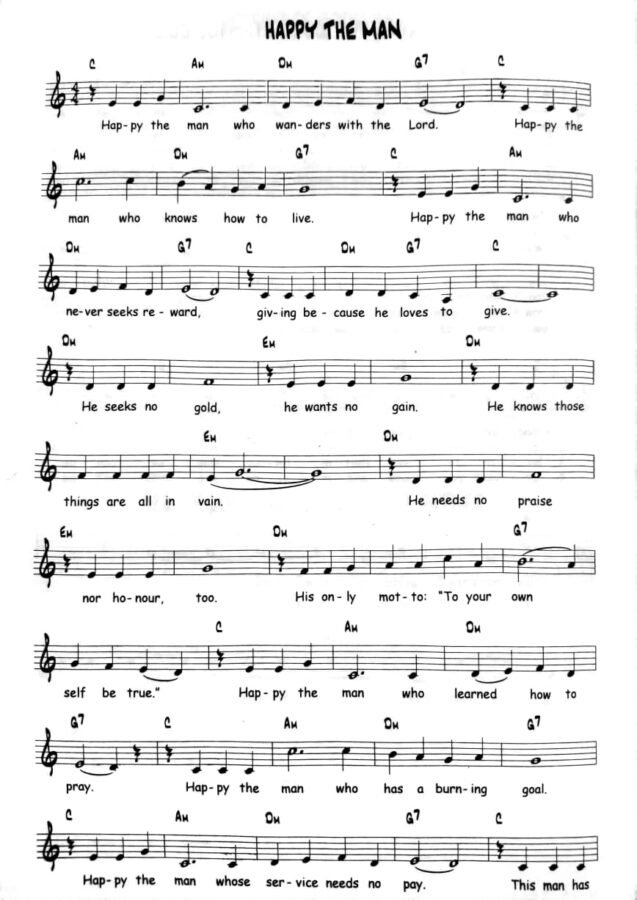
Happy the man who wanders with the Lord.
Happy the man who knows how to live.
Happy the man who never seeks reward,
giving because he loves to give.
He seeks no gold, he wants no gain.
He knows those things are all in vain.
He needs no praise nor honour, too.
His only moto: “To your own self be true.”
Happy the man who learned how to pray.
Happy the man who has a burning goal.
Happy the man whose service needs no pay.
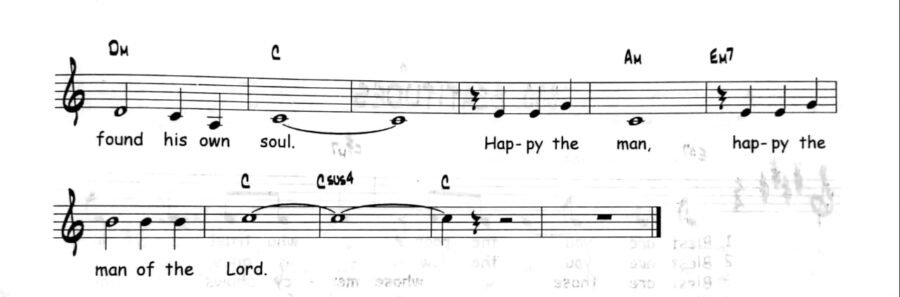
This man has found his own soul.
Happy the man, happy the man of the Lord.
If you are looking for the full Happy the man Lyrics, this beautiful, reflective hymn remains a beloved choice for liturgical worship and personal devotion. Loosely inspired by the Beatitudes and biblical wisdom, it serves as a powerful reminder of what it truly means to live a blessed, Christ-centered life. Below, we provide the complete lyrics, a deep dive into the song’s meaning, and practical guidance on incorporating it into Catholic worship.
Behind the Song: Sebastian Temple’s Work
This folk-style hymn was written by South African-born lay Franciscan Sebastian Temple (1928–1997), who is perhaps best known for composing the universally loved “Make Me a Channel of Your Peace.” Released originally in 1967, the song quickly found a home within contemporary Catholic liturgies and was eventually published by major liturgical music groups like GIA Publications.
Unlike many secular songs that define happiness through wealth, praise, or temporary satisfaction, this piece focuses on the spiritual joy that comes from absolute alignment with God’s will.
Exploring the Spiritual Meaning
The core theology of the hymn rests on the concept of spiritual detachments and selfless service. The opening lines, “Happy the man who wanders with the Lord,” frames life as a pilgrimage—a journey walked hand-in-hand with God rather than a static existence.
Key themes addressed in the verses include:
- Generosity Without Reward: The lyrics praise the person who loves to give without expecting anything in return. This directly echoes Christ’s instructions on hidden charity.
- Rejection of Materialism: By stating that gold and material gains are in vain, the song mirrors the warning in Luke 12:15 to guard against all greed.
- Humility Over Honor: The text calls us to bypass secular praise, aligning tightly with the core themes of Franciscan spirituality.
Liturgical Use in Catholic Mass
Because of its strong roots in Christian discipleship, this song is exceptionally well-suited as an entrance or recessional hymn. It pairs perfectly with Sunday liturgies focused on Christian living, the Beatitudes, or during the season of Ordinary Time.
If you are coordinating music for an upcoming Mass, feel free to browse our comprehensive database of Catholic Hymn Lyrics to find complementary songs for your playlist. For deeper reflection on the scriptural principles that inspired these verses, you can read the full text of the Beatitudes via the Bible Gateway portal.