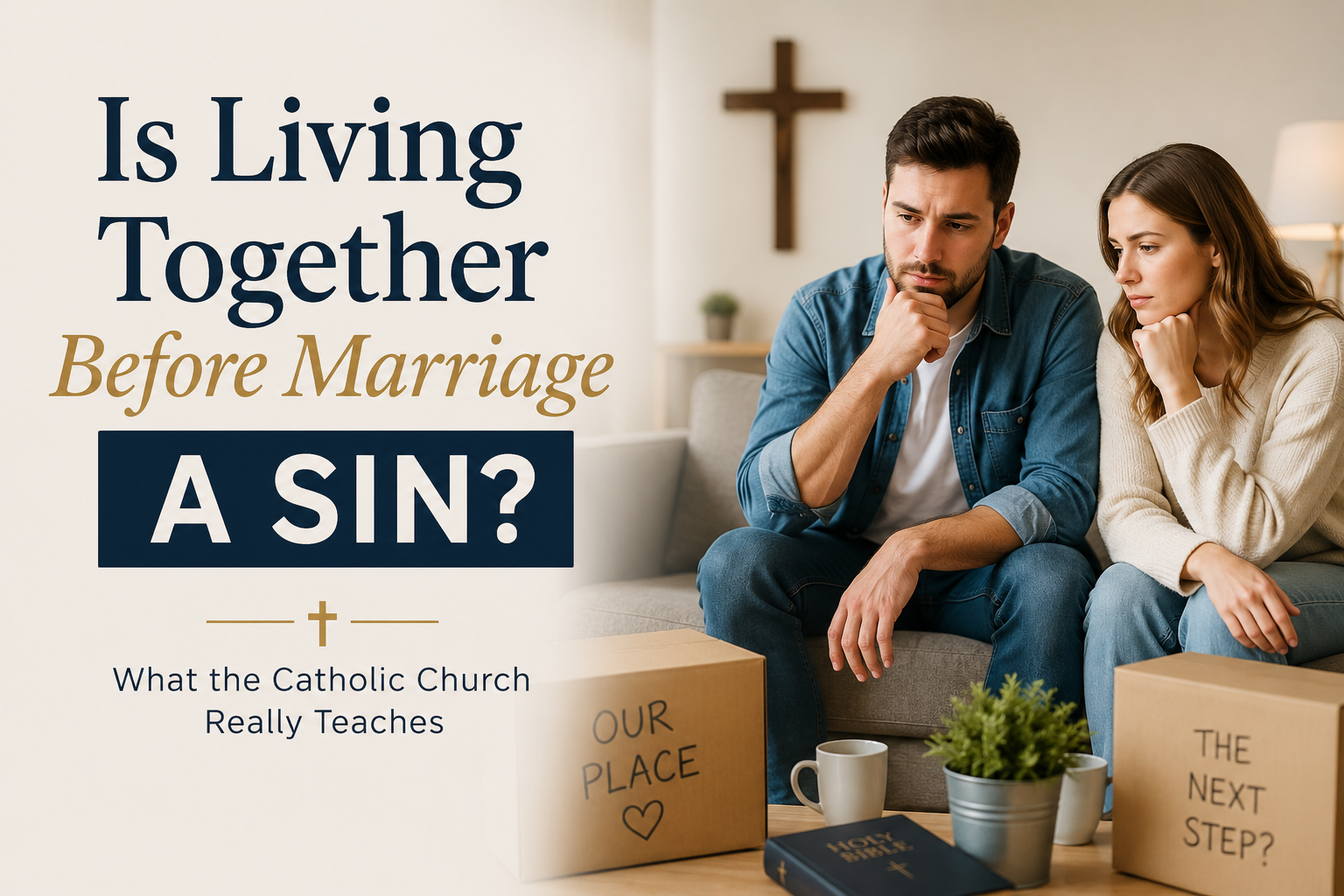
In today’s world, many couples choose to live together before getting married. Some do it to save money. Others want to “test compatibility” before making a lifelong commitment. Society often sees it as normal —even wise.
But what does the Catholic Church teach?
Is living together before marriage a sin?
The Catholic answer is yes—when a couple lives together as husband and wife without being married, especially when the relationship includes sexual intimacy. This is because sexual union belongs within the covenant of marriage, and living together in a way that imitates marriage can lead to serious moral and spiritual problems.
This teaching is not about judging people. It is about protecting the dignity of love, marriage, and the human person.
Let’s understand why.
What Does “Living Together” Mean?
Living together, often called cohabitation, means that an unmarried couple shares the same home as if they were husband and wife.
Sometimes this includes:
- sharing a bedroom
- having sexual relations
- sharing finances
- presenting themselves publicly as a couple
Other times, people live together for financial reasons without intending a romantic relationship. The Church distinguishes between these situations.
The moral issue arises when an unmarried couple lives together in a relationship that belongs properly to marriage.
What Does the Bible Say?
The Bible consistently teaches that sexual intimacy belongs within marriage.
Hebrews 13:4
“Let marriage be held in honor among all, and let the marriage bed be undefiled.”
Marriage is presented as holy. The “marriage bed” refers to sexual intimacy reserved for husband and wife.
Genesis 2:24
“Therefore a man leaves his father and his mother and cleaves to his wife, and they become one flesh.”
Notice the order:
- Marriage
- Becoming one flesh
Not the other way around.
1 Corinthians 6:18-20
St. Paul warns believers to flee sexual immorality because the body is a temple of the Holy Spirit.
Sex is not merely physical—it has spiritual significance.
What Does the Catechism Say?
The Catechism teaches that sexual relations belong only within marriage.
It explains:
“Sexuality is ordered to the conjugal love of man and woman.”
The Church further teaches:
“Carnal union is morally legitimate only when a definitive community of life between a man and a woman has been established.”
That “definitive community of life” is marriage.
Outside marriage, sexual relations contradict God’s plan for love.
Why Is Living Together Before Marriage Considered Wrong?
Many people ask:
“We’re planning to get married anyway. Why does it matter?”
The Church gives several important reasons.
1. Marriage Is a Total Gift of Self
Marriage is not simply living together.
It is a lifelong covenant where a man and woman freely promise:
- permanence
- fidelity
- openness to children
- complete self-giving
Sex expresses that total commitment.
Without marriage, the complete gift has not yet been made.
The physical union says,
“I give myself entirely to you forever.”
But without marriage, that promise has not actually been made.
2. It Separates Sex from Commitment
The Church teaches that love and responsibility belong together.
When couples live together outside marriage, sexual intimacy can become separated from the permanent commitment God intended.
This weakens the meaning of both love and marriage.
3. It Can Become a Near Occasion of Sin
Even couples who intend to remain chaste often discover how difficult it becomes while living together.
Sharing a home naturally creates constant temptation.
The Church encourages couples to avoid situations that make serious sin more likely.
4. It Can Cause Scandal
Catholics are called to witness to Christ.
When an unmarried Catholic couple lives together as though married, others may conclude that the Church’s teaching on chastity no longer matters.
This can unintentionally lead others into confusion.
“But We Love Each Other.”
Love is beautiful.
But love alone does not make a marriage.
A wedding ceremony is not merely a celebration—it is the public covenant through which God joins husband and wife.
Until then, the relationship has not yet become marriage.
Real love waits until it can give itself completely.
“We’re Living Together Only to Save Money.”
Financial hardship is real.
Rent is expensive.
Many couples genuinely struggle.
The Church understands these difficulties.
However, financial convenience alone does not change the moral meaning of living together as husband and wife outside marriage.
If a couple truly cannot marry immediately, they are encouraged to seek practical solutions while continuing to live chastely.
Many parishes can also provide pastoral guidance.
Does Living Together Make Marriage Stronger?
Many people believe that living together first reduces the chance of divorce.
Surprisingly, research has often shown the opposite.
While every couple is different, studies have frequently found that couples who cohabit before marriage do not necessarily enjoy stronger marriages and, in some cases, experience higher rates of marital difficulties.
The Church’s teaching is therefore not only spiritual but also reflects a deep understanding of human relationships.
What If We Have Already Been Living Together?
Many Catholics carry guilt over past choices.
The good news is that God’s mercy is greater than every sin.
Jesus never rejected those who sincerely turned back to Him.
If you have been living together before marriage:
- do not lose hope
- speak with a priest
- receive the Sacrament of Reconciliation
- begin living according to God’s plan
- prepare well for Christian marriage
The Church welcomes every sincere step toward holiness.
What If We Have Children Together?
Having children does not separate parents from God’s love.
The Church encourages parents to provide a stable family life and, if possible, to regularize their marriage.
Children deserve the security of a loving, faithful marriage whenever possible.
Can an Unmarried Couple Live Together Without Sin?
Sometimes yes.
For example:
- siblings
- elderly relatives
- roommates
- students sharing housing
- relatives caring for one another
The issue is not simply sharing a home.
The moral question concerns living together in a relationship that imitates marriage or includes sexual intimacy.
If an unmarried man and woman share a home for unavoidable reasons, they should avoid giving the appearance of marriage and should live in complete chastity.
What Should Catholic Couples Do Instead?
If you are dating seriously:
- Grow in friendship.
- Pray together.
- Attend Mass together.
- Receive the sacraments.
- Prepare carefully for marriage.
- Practice chastity.
- Build your relationship on trust rather than physical intimacy.
These habits create a stronger foundation than simply sharing a house.
Frequently Asked Questions
Is living together before marriage always a mortal sin?
Not every case involves the same level of personal responsibility. For a sin to be mortal, it must involve grave matter, full knowledge, and deliberate consent. Sexual relations outside marriage are grave matter, but personal culpability can vary depending on circumstances.
Can a Catholic marry in the Church if they were living together?
Yes. Many couples who have been living together later celebrate a valid Catholic marriage after proper preparation and, where needed, receiving the Sacrament of Reconciliation.
Does the Church reject couples who have lived together?
No.
The Church calls everyone to conversion while offering forgiveness, guidance, and hope.
What if we are engaged?
Being engaged is a beautiful step toward marriage, but engagement is not marriage itself. The Church still calls engaged couples to live chastely until their wedding.
Final Thoughts
Modern culture often says,
“Live together first, marry later.”
The Catholic Church proposes something very different.
It teaches that marriage is not merely the next stage of a relationship—it is the sacred covenant that gives sexual intimacy its true meaning.
Waiting until marriage is not about denying love.
It is about allowing love to become complete, faithful, permanent, and life-giving.
God’s plan may seem challenging, but it is ultimately a path toward deeper joy, stronger marriages, and lasting peace.
2 thoughts on “Is Living Together Before Marriage a Sin? A Catholic Answer”
Comments are closed.