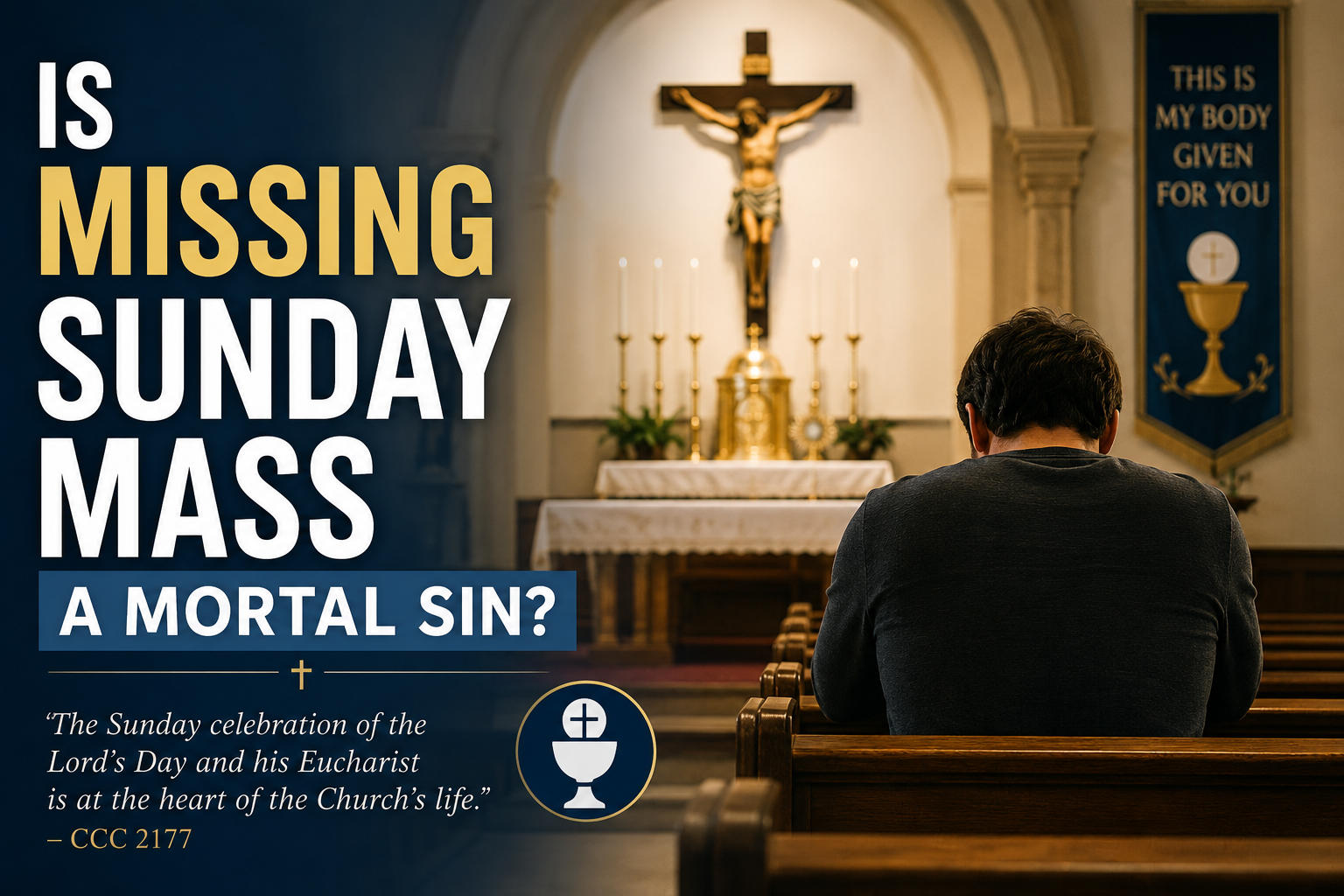
If you’re asking this question, Is Missing Sunday Mass a Mortal Sin? take a breath — the fact that your conscience is troubled at all is already a quiet sign that the Holy Spirit is at work in you. Let’s walk through this together, gently and honestly.
Short answer: Yes — deliberately and knowingly skipping Sunday Mass without a serious reason is grave matter, and when it’s done with full knowledge and full consent of the will, it is a mortal sin. But not every missed Mass is automatically a mortal sin. God looks at the full picture: what you knew, what you were free to do, and why you actually missed it. Many missed Sundays are not mortal sins at all.
Keep reading, because the why behind this teaching matters just as much as the answer — and it’s actually a love story before it’s a rule.
Why Does the Church Care So Much About Sunday?
Before we talk about sin, let’s talk about love — because that’s really where this teaching begins.
Sunday isn’t just “a day off” that the Church has turned into a rule. Sunday is the day the tomb was found empty. It’s the day death lost, and life won. From the very first Christians, believers gathered on “the first day of the week” specifically because that was the day Christ rose (Matthew 28:1; John 20:1). The Acts of the Apostles even shows the early Church already gathering on that day to break bread together (Acts 20:7), and St. John himself calls it “the Lord’s Day” (Revelation 1:10) — a name still used for Sunday today.
The Catechism puts it beautifully:
Sunday, the “Lord’s Day,” is the principal day for the celebration of the Eucharist because it is the day of the Resurrection. It is the pre-eminent day of the liturgical assembly, the day of the Christian family, and the day of joy and rest from work. Sunday is “the foundation and kernel of the whole liturgical year” (SC 106). (CCC 1193)
And even more directly:
The Sunday celebration of the Lord’s Day and his Eucharist is at the heart of the Church’s life. “Sunday is the day on which the paschal mystery is celebrated in light of the apostolic tradition and is to be observed as the foremost holy day of obligation in the universal Church.” (CCC 2177)
Sunday Mass is the one hour of the week where:
- You physically stand in the presence of the Risen Christ, not symbolically, but really — Body, Blood, Soul, and Divinity, in the Eucharist.
- You hear God speak to you directly through Scripture.
- You are joined to every other Catholic on earth offering the same sacrifice at the same altar of Heaven.
- Your soul receives grace it cannot manufacture on its own, no matter how good your private prayer life is.
This is why the Church doesn’t treat Sunday Mass as a minor devotional preference. It’s woven into the very identity of what it means to be Catholic — much the way the Sabbath was woven into the identity of God’s people in the Old Testament (Exodus 20:8-10). God didn’t give that commandment to burden His people. He gave it because He knows the human heart needs a rhythm of rest and worship, or it slowly drifts from Him without even noticing.
What Does the Catechism Actually Say?
Here is the teaching in the Church’s own words, plainly:
The precept of the Church specifies the law of the Lord more precisely: “On Sundays and other holy days of obligation the faithful are bound to participate in the Mass. The precept of participating in the Mass is satisfied by assistance at a Mass which is celebrated anywhere in a Catholic rite either on the holy day or on the evening of the preceding day.” (CCC 2180)
And then, the sentence that causes so many people to search this exact question late at night with a knot in their stomach:
The Sunday Eucharist is the foundation and confirmation of all Christian practice. For this reason the faithful are obliged to participate in the Eucharist on days of obligation, unless excused for a serious reason (for example, illness, the care of infants) or dispensed by their own pastor. Those who deliberately fail in this obligation commit a grave sin. (CCC 2181)
Notice that word again: deliberately.
The Church is not describing someone who tried to get to Mass and couldn’t. She is describing someone who knew the obligation, could have fulfilled it, and chose not to. That distinction changes everything, and we’ll come back to it in a moment.
It’s also worth knowing this teaching didn’t appear out of nowhere in a modern rulebook. It flows from the Third Commandment itself — “Remember the sabbath day, to keep it holy” (Exodus 20:8) — which the Church, guided by the Holy Spirit, has always understood as binding on the Lord’s Day for Christians.
The Three Conditions for Mortal Sin (Explained Simply)
This is the part most articles online skip past too quickly — and it’s the part that will actually bring you peace.
“Grave sin” and “mortal sin” are related, but they are not automatically the same thing. The Catechism is very precise here. For a sin to be mortal — meaning it severs your friendship with God and requires sacramental confession before receiving Communion again — three conditions must all be present at once:
Mortal sin requires full knowledge and complete consent. It presupposes knowledge of the sinful character of the act, of its opposition to God’s law. It also implies a consent sufficiently deliberate to be a personal choice. Feigned ignorance and hardness of heart 133 do not diminish, but rather increase, the voluntary character of a sin. (CCC 1859)
- Grave matter — The Church has already told us missing Sunday Mass without a serious reason qualifies as grave matter.
- Full knowledge — You genuinely understood, at the time, that this was a serious obligation (not something you vaguely half-remembered or were never properly taught).
- Deliberate, free consent — You freely chose to skip it. Nobody forced you, and no serious circumstance made it truly impossible.
If even one of these three is missing — if you didn’t fully know, or you weren’t truly free, or the matter wasn’t actually grave in your situation — the sin is not mortal. It may still be something worth bringing to confession, or it may not be sinful at all. God, unlike a courtroom, always looks at the heart (1 Samuel 16:7).
This is enormously important for tender consciences to hear: the Church’s teaching is not a trap. It exists to protect the seriousness of your relationship with Christ, not to catch you in a technicality.
When Missing Mass Is NOT a Mortal Sin
The Church herself lists real, legitimate reasons that excuse someone from the Sunday obligation entirely. The Catechism specifically names:
- Illness
- The care of infants
- Being dispensed by one’s own pastor
- The absence of a priest
- Other genuinely grave causes (CCC 2181)
In everyday life, this reasonably extends to situations like:
- Dangerous weather or unsafe travel conditions
- A family emergency or caring for a sick loved one
- Physical inability to leave the house
- No reasonable access to a Catholic Mass within a safe or practical distance
- Serious contagious illness (out of charity toward others, not just yourself)
If any of these genuinely applied to you, please hear this clearly: you did not sin by missing Mass. There is nothing to carry, nothing to be ashamed of, and nothing that needs to be confessed. Be gentle with yourself the way Christ is gentle with you.
What If There’s No Mass Available Where I Live?
If circumstances genuinely make Mass impossible — you live somewhere without a resident priest, you’re traveling, or you’re physically confined — the Church still wants that day set apart for God. She recommends:
- Praying the Liturgy of the Word, if a communion service is offered
- Personal or family prayer and Scripture reading
- Praying a Rosary or the Divine Mercy Chaplet as a family
- Making a spiritual communion — an ancient and beautiful practice of asking Jesus to come into your soul even when you cannot physically receive Him
None of these replace the Eucharist — nothing can — but they keep your heart oriented toward the Lord’s Day, which is really the whole point.
I Overslept and Missed Mass — Am I Guilty?
Ask yourself honestly, and without exaggerating either way:
- Did I stay up unreasonably late the night before, or ignore my alarm carelessly?
- Or did I genuinely try, set an alarm, intend to go — and something outside my control happened?
If you were careless and it was truly a free, knowing choice to prioritize sleep over worship, that leans toward the “deliberate” category the Catechism describes. If it was a genuine accident despite a sincere effort, your responsibility is lessened — possibly removed entirely.
Either way, here’s the good news: even in the first case, this is not a moment for despair. It’s a moment for honesty with God and, if needed, honesty in confession. That’s what confession is for.
I Had to Work on Sunday — Does That Count as an Excuse?
Many faithful Catholics — nurses, police officers, firefighters, hospital staff, transit workers — genuinely cannot avoid Sunday shifts. If your work truly, unavoidably prevents Mass attendance, that is a legitimate excusing cause. The Church has always recognized that necessary work and service to others can excuse someone from Sunday obligations they cannot help.
Even so, try to:
- Attend a Saturday evening Vigil Mass, which fully satisfies the Sunday obligation.
- Check for an early morning or late evening Mass on Sunday itself.
- Talk to your pastor if this is a recurring situation — many parishes are happy to help you plan around it.
I Deliberately Skipped Mass. What Do I Do Now?
If you’re reading this because you know, in your heart, that you chose comfort, laziness, a football game, extra sleep, or simple indifference over Mass — first: thank you for being honest with yourself. That honesty is itself a grace.
Here is what to do, step by step:
- Acknowledge it honestly before God, without minimizing it or exaggerating it.
- Make an act of contrition — even a simple, heartfelt “Lord, I’m sorry, help me” is real prayer.
- Go to Confession as soon as you reasonably can. Don’t let shame keep you away — the priest has heard this exact confession more times than you can imagine.
- Receive Communion again once reconciled, and go back to Mass this coming Sunday.
Remember the father in the parable of the prodigal son — he doesn’t wait at the door with a lecture. He runs to meet his child while he is still far off (Luke 15:20). That is exactly how God responds when you come back. Scripture promises: “If we confess our sins, he is faithful and just to forgive us our sins” (1 John 1:9). Not might forgive. Will forgive.
What the Saints Teach Us About the Gift of the Mass
Sometimes a rule becomes real to us only when we see how much the saints loved it — not because they were told to, but because they understood what was actually happening on the altar.
St. John Vianney, the humble parish priest who spent up to sixteen hours a day in the confessional, once told his people that if they truly understood the Mass, they would die of joy. He also taught his parishioners this striking comparison:
All the good works in the world do not equal the Holy Sacrifice of the Mass, “because they are the works of men; but the Mass is the work of God.”
St. Padre Pio, the stigmatist priest of San Giovanni Rotondo who was famously inseparable from the altar, said it even more dramatically:
“It is easier for the earth to exist without the sun than without the Holy Sacrifice of the Mass.”
And St. John Paul II, in his 1998 apostolic letter Dies Domini (“On Keeping the Lord’s Day Holy”), reminded the whole Church that Sunday was never meant to feel like a burden. He described the Lord’s Day less as a legal requirement and more as a rediscovery of the joy at the very heart of Christian life — a weekly Easter, a standing invitation from Christ Himself to His table.
These saints didn’t obey out of fear of breaking a rule. They ran to Mass because they had glimpsed what was actually there: Christ Himself, waiting.
Frequently Asked Questions
Is watching Mass online enough to fulfill my Sunday obligation?
Livestream Mass is a real spiritual help for those who are homebound, sick, or otherwise unable to attend in person — and it can bring genuine comfort. But it does not fulfill the Sunday obligation for someone who is physically able to attend in person, since the obligation is to participate in the Eucharistic sacrifice, not merely to observe it.
Does arriving late to Mass still count?
It depends on how much was missed and why. Traffic, parking, or getting children ready can cause an occasional late arrival that isn’t sinful at all. But habitually arriving late without any real effort to be on time is worth examining honestly — not as a technicality, but as a question of reverence for what’s actually happening at that altar.
Does a Saturday evening Vigil Mass count for Sunday?
Yes. The Church’s liturgical day begins at sundown the evening before (following the ancient Jewish reckoning found in Genesis 1), so attending Mass on Saturday evening fully and completely satisfies the Sunday obligation.
What if I’m not sure whether my situation counted as a “serious reason”?
When in doubt, bring the specific situation to confession or ask your parish priest directly. This is precisely what priests are there for, and no honest question about your conscience is ever too small or embarrassing to ask.
Is it a sin to miss Mass just once?
A single missed Sunday, on its own, is not automatically a mortal sin — it depends entirely on the three conditions above (grave matter, full knowledge, free consent). What matters far more than one missed Sunday is the direction of your heart: are you drawing closer to the Eucharist, or drifting from it?
A Final Word From the Heart
If you’ve read this far, it’s because you care — about your soul, about doing right by God, about not treating something sacred casually. That care is not anxiety to be ashamed of. It’s love, still alive in you, even if it feels bruised or uncertain right now.
Here is the truth underneath all of this teaching: the Sunday obligation was never meant to make you feel small. It exists because God wants you close to Him every single week — not distant, not guessing, not starving your soul of the one thing that actually feeds it. The Eucharist is not a reward for the perfect. It’s medicine and nourishment for people who are still on the road, still stumbling sometimes, still needing Him.
So if you’ve missed Mass and it was genuinely unavoidable — let it go. Do not carry guilt God never asked you to carry.
And if you’ve missed it and you know, quietly, that it was a real choice — don’t stay in that place either. Go to confession. Let the Lord say to you what He has been saying since the beginning: “Come to me, all you who labor and are burdened, and I will give you rest” (Matthew 11:28).
This Sunday, He’ll be there. The altar will be prepared. The door will be open. And He will be waiting for you the way the father waited for his son — already running toward you before you’ve even finished your prayer of sorrow.
2 thoughts on “Is Missing Sunday Mass a Mortal Sin? Catholic Answer”
Comments are closed.